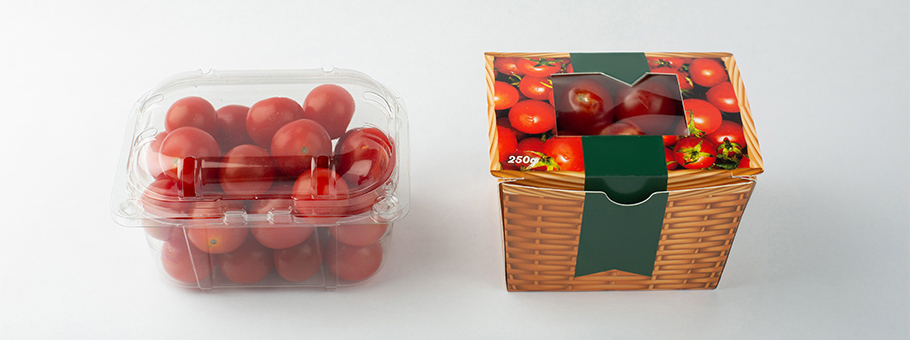
When we think about sustainable food packaging, cardboard can seem like the obvious environmental choice. It’s made from a renewable resource, it looks natural and, when clean and correctly designed, it can be readily recycled.
Plastic, on the other hand, is often viewed as the less sustainable option.
But when comparing recycled PET (RPET) with cardboard for food packaging, the answer isn’t as simple as plastic versus paper.
The environmental impact of food packaging needs to consider its entire lifecycle, including how much recycled material it contains, how effectively it protects food, its weight during transportation, whether it can be recycled after use and how successfully that material can be returned to the manufacturing cycle.
For many food applications, these factors make RPET a compelling packaging material.
What is RPET?
PET, or polyethylene terephthalate, is a plastic originally derived from fossil-fuel-based raw materials.
The important difference with RPET is the “R”, which stands for recycled.
Rather than manufacturing packaging entirely from virgin PET, recovered PET can be cleaned, processed and turned back into food-grade packaging.
Depending on the packaging specification and manufacturing process, RPET food packaging can contain up to 100% recycled PET.
This creates the opportunity to keep an existing material in circulation rather than treating plastic as a single-use resource.
RPET Can Be Recycled Again and Again
One of the greatest advantages of clear PET is its potential to operate within a circular economy.
When PET food packaging is correctly collected, sorted and processed, the material can be recovered and used to manufacture new products, including new food-grade packaging where appropriate recycling systems and processes are available.
Clear PET has been reported as being capable of being recycled up to nine times, although the actual number of cycles depends on material quality, collection, contamination, processing technology and the intended next use.
This is what makes the circular economy different from the traditional “take, make and dispose” approach.
Instead of becoming waste after a single use, PET has the potential to become a raw material again.
The Challenge with Cardboard Food Packaging
Cardboard has many environmental advantages and can be highly recyclable in the right application. However, food packaging creates additional challenges.
Untreated cardboard does not naturally provide the level of resistance to moisture, grease, oxygen and other elements required by many fresh foods.
To provide those properties, cardboard food packaging may require a barrier coating, film or liner.
Depending on the materials used and the design of the packaging, these additional layers can make recycling more complicated. Plastic-laminated cardboard, for example, requires the fibre and plastic components to be separated during processing, and some material can be lost in the process.
New recyclable and water-based coatings are improving this situation, but the important point is that a cardboard pack isn’t automatically recyclable simply because its main material is cardboard.
Packaging needs to be considered as a complete product.
Better Protection Against Moisture
Fresh food and moisture go hand in hand, which is where the natural properties of PET can provide an advantage.
RPET offers excellent resistance to moisture, helping protect food without relying on the additional moisture-resistant coatings commonly required for fibre-based packaging.
For cardboard to perform the same job in many food applications, additional barriers may be required.
The more complex a package becomes, the more important it is to consider what happens to all of those materials at the end of its useful life.
Keeping Food Fresher for Longer
Packaging itself represents only part of the environmental equation.
We also need to consider the food inside it.
Good food packaging needs to protect freshness and provide the appropriate environment for the product throughout transportation, retail display and storage.
The barrier properties of PET, combined with packaging design, sealing and ventilation where required, can help maintain the conditions needed to protect fresh food.
Cardboard can also provide effective food packaging, but achieving the required moisture and gas barriers can depend heavily on its coatings, liners and overall pack design.
Why does that matter?
Because food that is damaged or spoils before it is eaten represents wasted resources throughout its entire supply chain.
Choosing packaging should therefore be about more than simply reducing the amount of packaging. It should also consider how effectively that packaging protects the food inside it.
Lightweight Packaging Can Mean Less to Transport
Another important consideration is weight.
Thermoformed RPET can create lightweight food packaging while maintaining strength and rigidity.
Reducing packaging weight can reduce the amount of material being transported alongside the product. Across thousands or millions of packs moving through a supply chain, packaging weight can become an important factor in overall transportation impacts.
However, the carbon footprint of RPET versus cardboard varies by package design, recycled content, manufacturing energy, transport distances and end-of-life treatment. The lightest package is not automatically the lowest-carbon package.
This is why packaging needs to be assessed for its specific application rather than by material alone.
Strong, Rigid Protection
Packaging also needs to survive the journey from producer to consumer.
Thermoformed RPET can provide a high level of rigidity and structural protection relative to its low weight, helping protect delicate foods against crushing and damage during handling, stacking, transportation and retail display.
Cardboard can also be engineered to provide excellent structural strength, but moisture can affect fibre-based materials and some food applications require additional coatings or structural material to achieve the required performance.
Protecting the food is an important part of sustainable packaging.
If inadequate packaging results in damaged or wasted food, reducing the environmental impact of the packaging alone doesn’t necessarily reduce the impact of the complete product.
Creating a Circular Economy for Food Packaging
The real opportunity with RPET isn’t simply replacing cardboard with plastic.
It’s about changing how we think about plastic in the first place.
In a linear system, virgin raw materials are turned into packaging, used once and discarded.
In a circular system, PET packaging is collected, correctly sorted, recycled and returned to manufacturing as RPET.
That recycled material can then become packaging again.
New Zealand already has the capability to take post-consumer PET and turn it back into food-grade RPET packaging, demonstrating how recovered PET can become a valuable local manufacturing resource rather than waste.
The more effectively PET is collected and returned to this system, the less reliant packaging manufacturing can become on virgin PET.
So, is RPET Better Than Cardboard?
There isn’t a universal answer.
For some food products, recyclable fibre-based packaging may be an excellent environmental solution. For others, RPET can provide a better combination of recycled content, low weight, food protection, moisture resistance, durability and circularity.
The important question shouldn’t simply be:
“Is plastic or cardboard better?”
It should be:
“Which packaging solution protects this food effectively while using the fewest resources and creating the best opportunity for those materials to remain in circulation?”
For many fresh food applications, well-designed RPET packaging provides a strong answer.
How CustomPak is Helping Close the Loop
At CustomPak, we believe the future of food packaging is about making better use of the materials already available to us.
Wherever possible, our thermoformed packaging is manufactured using RPET with up to 100% recycled content, helping give recovered PET another useful life.
Our packaging is designed to be lightweight while providing the rigidity, clarity and protection required by New Zealand food producers.
With manufacturing facilities in Auckland and Christchurch, we can also manufacture packaging closer to customers in both the North and South Islands, reducing unnecessary freight distances and the associated transport emissions.
It’s all part of working towards a more circular approach to food packaging, where valuable materials are recovered, recycled and put back to work rather than becoming waste.
Because sustainable packaging isn’t just about what it’s made from. It’s about how well it protects what’s inside, how efficiently it gets there and what happens to the material next.
Sources & Supporting Information
The information in this article is supported by independent New Zealand and international research. The New Zealand Ministry for the Environment identifies PET as a recyclable material capable of being recycled multiple times, while the Office of the Prime Minister’s Chief Science Advisor has documented New Zealand’s ability to recover PET and process it into food-grade rPET packaging. Research into paper and cardboard food packaging also shows that barrier coatings and laminates are often required to provide moisture and gas protection, which can affect the recyclability of fibre-based packaging.
Environmental outcomes can vary depending on packaging design, recycled content, food application, transport, local recycling infrastructure and end-of-life processing.